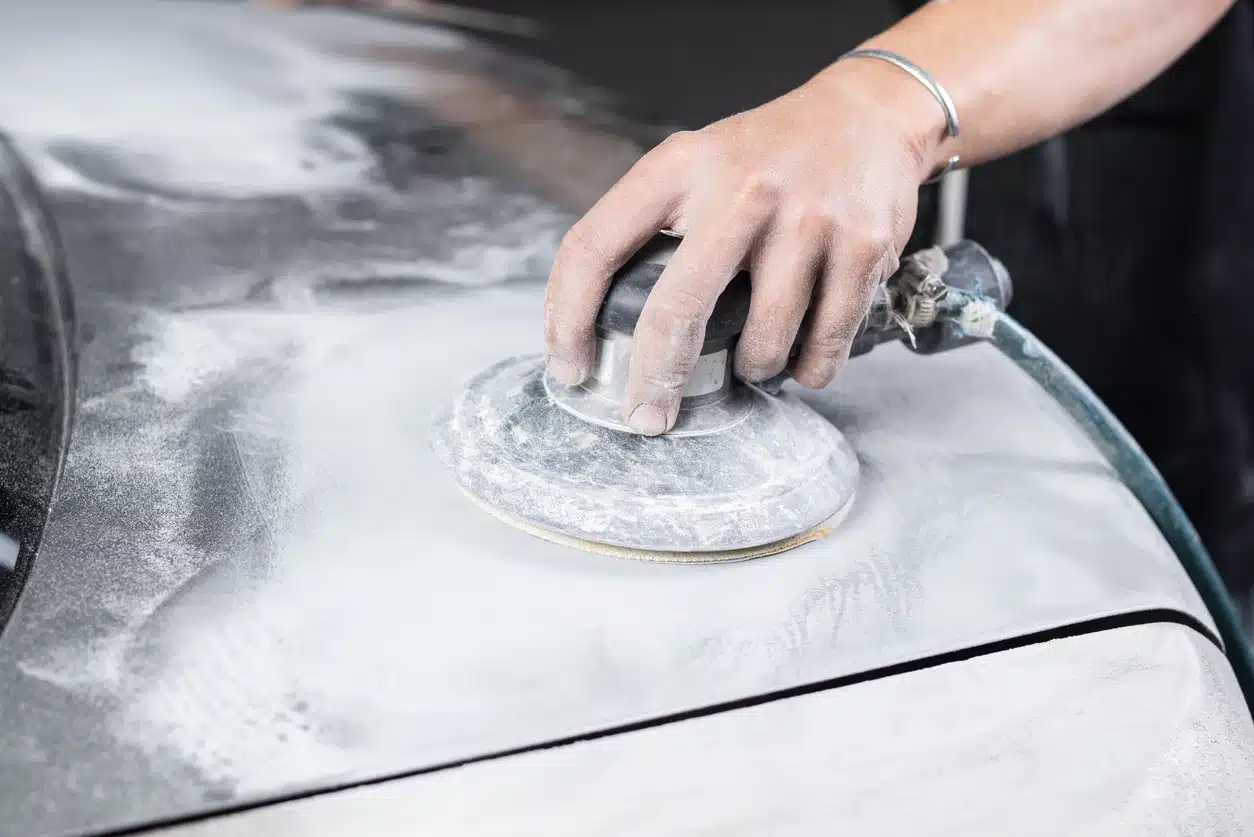
Body shops must comply with OSHA’s General Dust Exposure Limits as enforced under 29 CFR 1910.1000, which establishes permissible exposure limits (PELs) for airborne contaminants. Where dust exposure cannot be eliminated, employers are legally required to implement effective control measures to reduce employee exposure to acceptable levels.
Depending on the materials being sanded and the substances contained within the dust, additional OSHA standards may also apply.
In short, it is a legally binding responsibility for employers to ensure employees are protected by implementing appropriate engineering controls, safe working practices, personal protective equipment (PPE), and training in order to comply with OSHA regulations and CDC-recommended occupational health practices.
What is Body Shop Dust?
Body shop dust refers to the tiny, invisible particles created when power tools like disc sanders are used on vehicle bodywork. Whether your team are working on a painted surface or applying and sanding body filler, a mixture of fragments containing different metals and chemical compounds enters the air.
Without proper precautionary measures, body shop dust can be harmful to employees or customers, regardless of whether there are any harmful substances mixed into the dust particles. In a body shop, dust typically consists of heavy metals like lead, aluminium and chromium which all pose a threat to humans if inhaled.
It’s important to note that there are two types of dust: inhalable and respirable. Inhalable dust is any airborne material that can enter the nose and mouth while breathing. Some dust particles might be larger or heavier and can get trapped in the nose, mouth, throat or upper respiratory tract. Respirable dust, on the other hand, is any airborne material able to reach the gas exchange region of the lungs. These types of particles can build up in the air spaces within the lungs and cause irreparable damage.
How to Detect Body Shop Dust
Before effective control measures can be put in place, body shops must first understand what is actually present in the dust being generated. The composition of body shop dust can vary significantly depending on the materials and processes used, which is why identification is a critical first step.
The starting point is to review Safety Data Sheets (SDS) for all materials involved in sanding and surface preparation, including:
- Body fillers and putties
- Abrasives (such as sanding discs and sheets)
- Primers and paints
When reviewing SDS documents, particular attention should be paid to the composition/information on ingredients and hazard identification sections. These sections will highlight whether hazardous substances are present, such as respirable crystalline silica, lead, or chromium, all of which are commonly associated with automotive repair materials and coatings.
Once potential hazards have been identified, OSHA requires employers to determine whether workers are being exposed to these substances at harmful levels. OSHA also mandates exposure assessment and monitoring when employees may be exposed to regulated hazardous dusts, including silica, lead, and hexavalent chromium.
Exposure assessment can be carried out using a combination of air sampling data and objective data. Air sampling involves measuring the concentration of airborne dust in the breathing zone of employees during normal work activities. Objective data may include industry studies, manufacturer testing, or historical sampling results that accurately reflect the conditions in the body shop.
By correctly identifying hazardous components in dust and assessing employee exposure levels, body shops can make informed decisions about the controls, equipment, and procedures needed to remain compliant with OSHA regulations and protect worker health.
How to Control Body Shop Dust
Controlling the dust in your body shop is a crucial step in the right direction towards achieving good health and safety standards. Forgetting to take these precautions – even just on one occasion – could put the health and lives of your employees at risk. Dust particles can linger in the air for long periods, which is why it’s important to understand the full extent of what’s needed to control the dust produced in your body shop.
Taking the necessary steps to control body shop dust can lead to numerous benefits such as fewer sick days for your staff, easier cleaning procedures, and a more professional workspace. To achieve full control over the dust created in your automotive body shop, you can use dust extraction, ensure proper use of masks, and provide adequate ventilation. Below, we will explain how each of these works.
Dust Extraction
Dust extraction remains one of the most effective ways to control body shop dust, as it captures particles at the source before they can disperse into the wider work environment. OSHA-approved dust extraction systems should be used to ensure compliance with US occupational safety requirements and to help keep airborne dust levels below permissible exposure limits.
Modern body shops commonly use cyclone separators, HEPA-filtered vacuums, or central extraction systems to control dust generated during sanding and surface preparation. Cyclone systems are designed to separate heavier dust particles before they reach the filter, improving efficiency and extending filter life. HEPA (High-Efficiency Particulate Air) vacuums are particularly important when working with fine or hazardous dusts, as they are capable of capturing very small respirable particles. Central extraction systems can also be installed to serve multiple workstations, providing consistent dust control across the shop.
Any dust extraction equipment used should be suitable for the type of dust being generated and maintained in line with manufacturer instructions and OSHA requirements. Effective at-source extraction reduces reliance on PPE and general ventilation, as the majority of dust is removed before it becomes airborne.
PPE (Personal Protective Equipment)
Inhaling or coming into contact with hazardous dust particles can be extremely harmful, which is why appropriate PPE is essential in automotive body shops. When engineering controls such as dust extraction and ventilation are not sufficient to reduce exposure below OSHA’s Permissible Exposure Limits (PELs), employers must provide NIOSH-approved respirators. Respiratory protection should be selected based on the type and concentration of dust present and must fit properly to be effective.
In addition to respiratory protection, employers should provide disposable coveralls to prevent dust from accumulating on personal clothing and being carried outside of the work area. This is particularly important when working with hazardous substances such as silica, lead, or chromium. Appropriate gloves, such as nitrile gloves, should also be provided to reduce skin contact with dust and contaminated surfaces.
Chronic exposure to metal and mineral dusts can lead to serious long-term health issues, including respiratory disease and skin irritation. OSHA requires employers not only to supply appropriate PPE but also to train employees on its correct use, limitations, and maintenance to ensure it provides effective protection.
Local Exhaust Ventilation
Local Exhaust Ventilation (LEV) plays a critical role in controlling body shop dust by removing contaminated air directly from the point where dust is generated. Unlike general ventilation, LEV systems are designed to capture dust immediately, reducing the amount that becomes airborne and is inhaled by workers.
Common LEV solutions in body shops include ventilated sanding stations, downdraft tables, and wall-mounted extraction units. Ventilated sanding stations and downdraft tables pull dust away from the breathing zone and downward into a filtration system, making them particularly effective for sanding operations. Wall-mounted extraction systems can be positioned close to the work area to capture dust at source without restricting movement.
To be effective, local exhaust ventilation systems must be properly designed, positioned, and maintained, and filters should be inspected and replaced as required. When used alongside dust extraction and PPE, LEV helps maintain safer air quality levels and supports compliance with OSHA dust exposure requirements.
Ventilated Sanders
Ventilated sanders are power sanding tools designed with built-in ports that connect directly to a local exhaust ventilation (LEV) system, allowing dust to be captured at the point it is generated. Instead of releasing fine particles into the air, these tools pull dust through the sanding pad and into an attached extraction system, significantly reducing airborne contamination in the work area.
Sanding operations in body shops can generate large amounts of fine, respirable dust containing hazardous substances such as crystalline silica, lead, or chromium, all of which pose serious health risks if inhaled. By capturing dust immediately, ventilated sanders help reduce the concentration of airborne particles in the worker’s breathing zone.
For ventilated sanders to be effective, they must be connected to a properly designed local exhaust system, such as a HEPA-filtered vacuum, central extraction unit, or dedicated dust collection system. Without adequate local exhaust, the ventilation ports alone are not sufficient to control fine dust. The extraction system must provide enough airflow to continuously remove dust while sanding is taking place.
When used correctly, ventilated sanders offer several advantages, including improved air quality, reduced reliance on respiratory PPE, better visibility during sanding, and easier cleanup.
What are the Hazards of Body Shop Dust?
As we’ve touched on, body shop dust poses hazardous risks to human health. So, what are the main hazards? Our list below includes various health hazards linked to body shop dust:
- Inflammation and/or irritation of airways and/or lungs
- Breathing problems
- Lung conditions often associated with long-term dust exposure, such as siderosis, which is a lung disorder that can lead to further complications like pneumonia
- Skin issues such as dermatitis from contact with harmful chemicals
- Eye irritation
Body shop dust can also cause other hazards. If dust is allowed to settle, it can fall on the surfaces around your body shop and contaminate other work. Similarly, it can cause hazards during the cleaning process since the dust will need to be removed from the workbenches and your tools to keep these in good working order. To help with this, it can be a good idea to use surface protection film on delicate surfaces within your workshop if you’re aware that dust will be produced.
Whether you’re looking for new ways to protect your staff from potential health and safety hazards or are building up your knowledge of the rules and regulations around working in a body shop, our expert guide includes a comprehensive view of body shop dust and how to control it.
From our experts to yours, at JTAPE, we’re here to pass on our extensive knowledge and tips on all things automotive-related. Check out our blog to discover more of our excellent guides, or explore our range of high quality masking products for your body shop.